Community Development
Community Development
What community development means, how neighborhoods rebuild through investment, organizing and planning, and where housing and finance fit in.
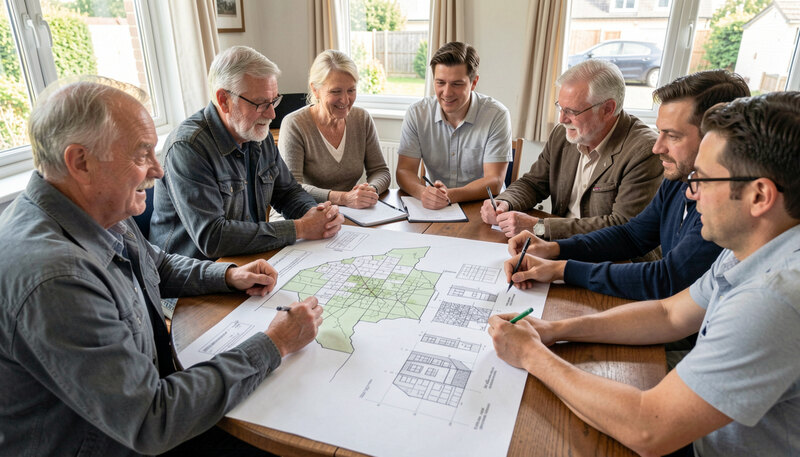
Community development is the work of rebuilding neighborhoods from inside them: housing repaired, commerce revived, residents organized, capital persuaded to arrive and stay. This section gathers the guides that explain how that work actually functions in the United States. It begins with the core definition, follows the process of neighborhood revitalization step by step, and closes with the money, who invests it, through which channels, and for whose benefit.
What belongs in this section?
Three guides anchor it. The first defines the field: community development as a discipline with history, actors and boundaries, distinct from charity and from city government. The second follows a place through time: the stages of neighborhood revitalization, from the first resident meetings to the mixed use block, naming who funds each stage and how residents keep a say. The third turns to capital: community investment, the lenders, funds and tax programs that move money into census tracts the market ignores. Together they answer the question a newcomer arrives with, which is not what is wrong with a neighborhood but what has actually worked elsewhere.
Who does the work?
The cast is easy to confuse at first, so the section keeps it in order. Residents organize first, through associations and, in strong traditions like Washington DC's tenant movement, through purchase rights that make them owners. Community development corporations execute: they are the nonprofit developers that assemble land, financing and contractors. Government sets rules and supplies public money, from block grants to trust funds. Lenders supply the credit, increasingly through certified community development financial institutions. Foundations and intermediaries pay for the thinking, the planning and the risk that no one else will hold. Each guide names these actors precisely because projects fail when one layer is mistaken for another.
How should a reader use the guides?
The natural reading order follows the sequence of a real project. Start with what community development is for vocabulary and history: what a community development corporation does, what distinguishes development from charity, why housing and local power travel together. Then read how neighborhood revitalization works for process: planning, early wins, the housing anchor, the safeguards against displacement. Finish with what community investment means for the money: instruments, providers and the honest limits of the field. A reader who needs the building blocks of housing itself, incomes, programs, vouchers and tax credits, should move next to the affordable housing section; a reader who needs the lenders in detail should open the community finance section.
What does success look like?
The field's own measure of success has shifted over fifty years, and the guides reflect the shift. Early programs counted units produced and dollars spent. Today's stronger question is who remains: whether the residents who organized the revival are still there to benefit from it, whether local businesses survive the rising rents that improvement brings, whether the housing built stays affordable for decades rather than years. Ownership structures, land trusts, cooperatives, long term covenants, have moved from the margins to the center of practice for exactly this reason. The revitalization guide returns to this test at its close.
What does Washington DC add?
The District is one of the country's richest laboratories for this work, and it has its own section. A tenant purchase law from 1980, a housing trust fund created in 1988, a dense nonprofit development community and a long line of mission lenders, including the loan fund this domain once hosted, make DC a case where every instrument described in these guides has a local address. The Washington DC section maps the programs, tells that history and lists the local help available to residents and organizations.
What terms should a reader hold onto?
A short glossary prevents most mixtures. A community development corporation is a nonprofit developer, not a government office. Community development financial institution is a Treasury certification, not a self description, and it covers banks, credit unions and loan funds under one label. Displacement is the departure of existing residents from a improving area, whether by eviction, tax pressure or sale. Community benefit agreement is a negotiated contract between a developer and neighborhood groups. Each term has a full definition inside the guide that owns it, and the guides cross link rather than repeat.
Where to begin?
Begin with the definition. Most confusion in this field starts with vocabulary: development mistaken for gentrification, community investment mistaken for charity, revitalization mistaken for construction. Half an hour with the first guide prevents the errors the later guides build upon, and every later page links back to the terms defined there. The three guides together run well under an hour of reading and leave a reader able to follow a real project meeting without translation.
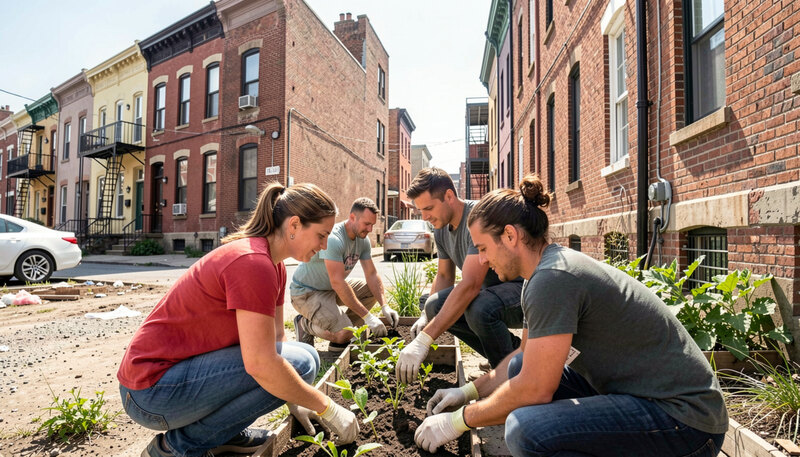
What Is Community Development?
A plain definition of community development: who does it, what it funds, how it differs from charity, and why it pairs housing with local power.
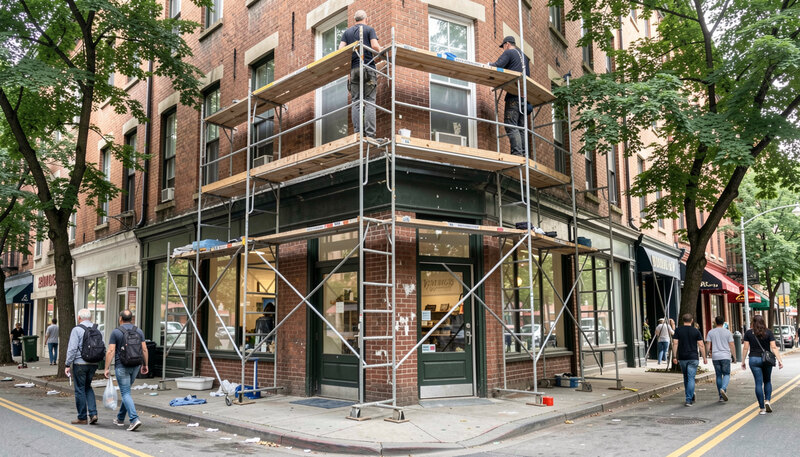
How Neighborhood Revitalization Works
From vacant lots to main streets: the stages of neighborhood revitalization, who funds each step, and how residents keep a real say.

What Is Community Investment?
How community investment moves money into underserved neighborhoods through CDFIs, funds, banks and public programs, and what it pays for.